
Post-Impressionism / Musée d'Orsay
Starry Night Over the Rhône
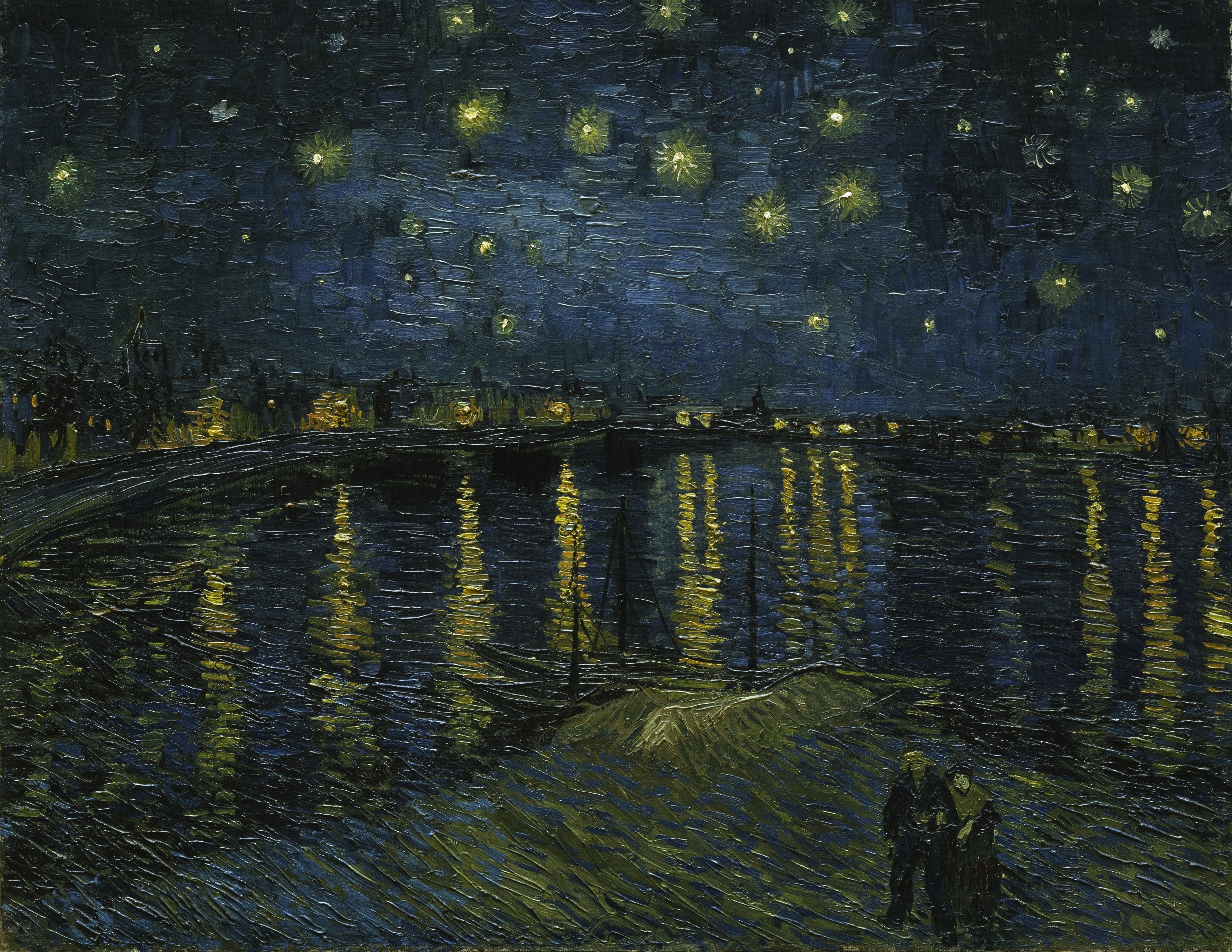
Yellow lights fall through the blue Rhône in long broken columns, while two figures stand almost unnoticed at the edge of the water. In Starry Night Over the Rhône, Vincent van Gogh does not make darkness empty or black. He builds it from blue, violet, green, gold, and reflected light.
Painted at Arles in September 1888, the canvas shows a real nocturnal view, but it is not a neutral record. Van Gogh organizes the night so that stars, gas lamps, river, boats, and lovers answer one another. The painting's meaning lies in that exchange: distant light becomes physical color, and a large modern landscape becomes unexpectedly intimate.
Title note: the Musée d'Orsay records the work as La Nuit étoilée. The common English title Starry Night Over the Rhône distinguishes it from MoMA's The Starry Night, painted at Saint-Rémy in 1889.
See the painting in 30 seconds
- Begin with the yellow reflections in the Rhône.
- Move upward to the stars and the Great Bear.
- Compare natural starlight with the modern light of the gas lamps.
- Notice the dark boats and mooring lines in the foreground.
- Find the couple at the lower right: they give the night a human scale.
- Step back and compare this horizontal calm with the more turbulent sky of MoMA's The Starry Night.
A night painted beside the Rhône
The Musée d'Orsay records the painting as an oil on canvas from 1888 measuring 73 by 92 cm. Van Gogh chooses a real view of the Rhône at Arles, but organizes town, river, and sky around a precise contrast between blue depth and yellow light.
A letter to Theo dated around September 29 confirms that Van Gogh painted the starry sky outdoors at night, under a gas lamp. He describes a green-blue sky, royal-blue water, mauve ground, a blue-violet town, yellow gaslight, and reflections descending through red-gold toward green-bronze. The canvas turns that precise color plan into a lived atmosphere.
Why did Van Gogh paint the night in Arles?
Van Gogh arrived in Arles in February 1888 hoping to renew his color through the light of the South. His aim was not to reproduce black darkness, but to make night visible through color. He studied the deep blues of sky and Rhône, the yellow lamps, and the way water stretches and fragments their reflections.
The modern city therefore became as important as the stars. Gaslight does not destroy the night; it gives it a second, more earthly rhythm of light, which the river brings into relation with the sky.
What the painting shows
The sky occupies the upper part of the image, scattered with bright stars and the Great Bear. A low strip of Arles runs across the horizon. Lamps along the opposite bank cast yellow and orange reflections into the Rhône. Their vertical trails are repeatedly broken by the horizontal movement of the water.
In the foreground, boats and mooring lines form dark, angular shapes. The bank enters from the lower right, where a couple walks close together. These two figures are small, but they change the scale of the whole scene. The sky and river remain vast; the night also becomes a place inhabited by ordinary closeness.
Composition: light above, light below
The composition is divided into broad horizontal bands: sky, town, water, and bank. Van Gogh then cuts across that stability with the lamps' vertical reflections and the strong diagonals of the foreground shore. The result feels calm without becoming static.
The stars above and the gaslight below form two related systems. One belongs to the sky, the other to the modern city, yet both arrive in the painting as points of yellow light. The Rhône joins them. Reflections stretch the city lamps downward, while the painted surface makes stars and street lighting part of one chromatic rhythm.
Blue is not background
Blue controls almost every part of the image, but it never behaves as one flat color. Dark blue-black presses around the edges. Royal blue opens the water. Green-blue and violet move through the sky and town. Against that field, yellow, orange, pink, and green lights appear unusually intense.
Van Gogh's brushwork keeps each zone active. Short, directional strokes build the sky; broken horizontal marks make the river tremble; thicker lines define boats, shore, and figures. The touch does not simply describe surfaces. It gives each part of the night a different tempo.
Natural stars and modern gaslight
The painting is often remembered as a poetic night scene, but modern technology is central to it. The orange lights are gas lamps from the town. Their reflections are longer and more forceful than the stars themselves. Van Gogh does not place nature against modern life as simple opposites. He lets artificial light enter the river and compete with the sky.
That contrast gives the painting its Post-Impressionist structure. Observed reality remains recognizable, but color is intensified and organized for expressive force. The town, stars, and water are not copied evenly. They are rebuilt around the emotional charge of blue darkness and yellow light.
Not the same as The Starry Night
At Arles in 1888, Van Gogh paints a river, reflections, a real town, and modern lighting within a calm horizontal composition. At Saint-Rémy in 1889, the Museum of Modern Art's The Starry Night places a village beneath a swirling sky: movement becomes cosmic and the composition more visionary.
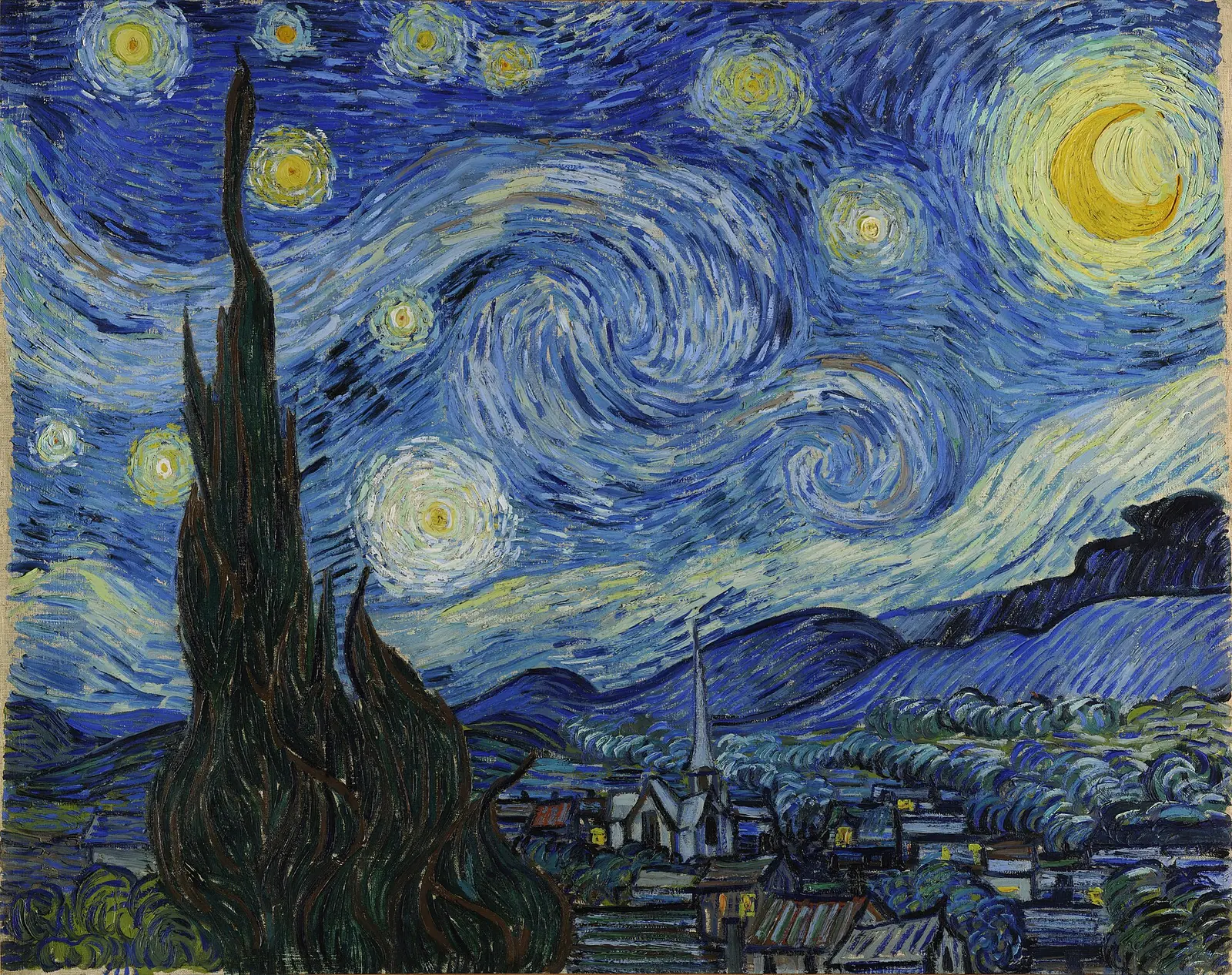
The difference is not simply between observation and imagination: both paintings transform the visible world. At Arles, water carries the movement; at Saint-Rémy, the sky takes over that role.
One night reflects; the other turns.
Why the painting still holds attention
Starry Night Over the Rhône remains powerful because it keeps several kinds of night together. The scene is observed and constructed, urban and intimate, natural and technological. Stars shine overhead; gas lamps enter the water; boats sit in darkness; two people walk near the edge.
Van Gogh makes darkness visible without destroying its mystery. The blue field remains deep, but every yellow light opens a route through it. The eye moves from star to lamp, from lamp to reflection, from reflection to the couple, and then back into the scale of the sky.
The night is not empty: Van Gogh makes it a meeting place for stars, modern light, water, and human closeness.
Continue from Van Gogh
Think you can recognize Van Gogh by his brushwork and color? Try the Explainary art quiz.
Primary sources
Frequently asked questions
It shows the Rhône at Arles at night, with stars, city gas lamps, long reflections on the water, boats, and a couple in the foreground.
Van Gogh presents night as richly colored rather than black. Natural stars and modern gaslight meet in the water, while the couple makes the vast scene intimate.
No. Starry Night Over the Rhône was painted at Arles in 1888. The Starry Night was painted at Saint-Rémy in 1889 and has a more turbulent, invented sky.
The painting is in the Musée d'Orsay in Paris.